



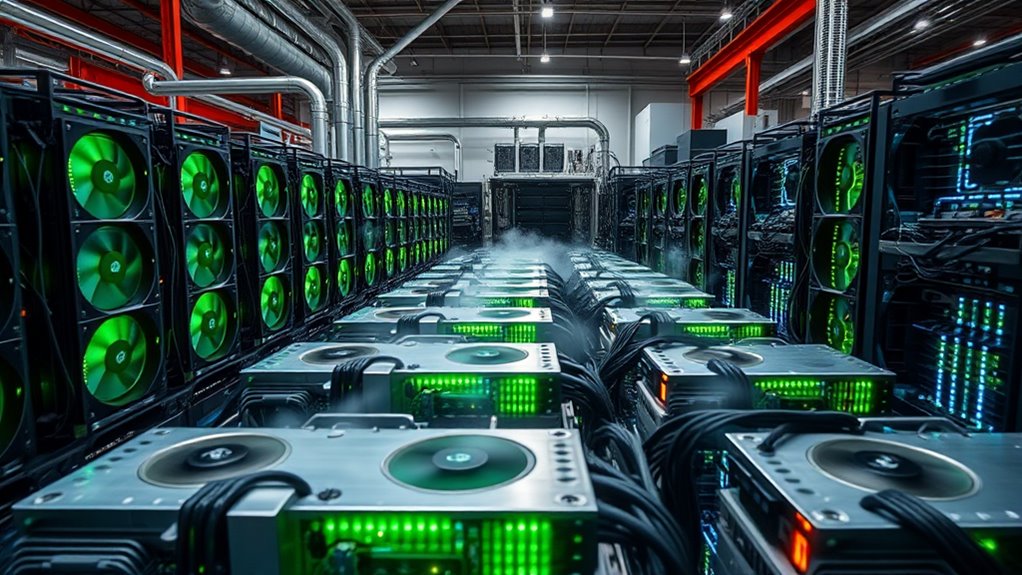
What Is Crypto Mining?

Crypto mining is basically the race where computers compete to solve tricky math problems. Why? To verify transactions and secure blockchains, of course. Miners use a ton of energy—like, more than some countries—while hoping to snag cryptocurrency rewards. It's a chaotic mix of hardware investments and fluctuating crypto prices. Fun, right? And let's not forget, miners are the gatekeepers against fraud. Want to know more about the wild world of crypto mining?

Crypto mining might sound like a techy buzzword thrown around by the financially savvy, but at its core, it's pretty straightforward. It's about validating transactions and adding them to a blockchain ledger. Picture a bunch of computer whizzes competing to solve complex math problems—this is known as Proof-of-Work. It's like digging for gold, but instead of shovels, these miners use computational power to "mine" cryptocurrency. And guess what? They help maintain network security and stop any sneaky double-spending.
Here's how it works: miners race to crack cryptographic hash functions. The first one to succeed shouts "Eureka!" and broadcasts the solution to the network. New blocks get added to the blockchain roughly every ten minutes, like clockwork. But here's the kicker: block rewards don't stay the same forever. They decrease over time, thanks to events like Bitcoin halving. Talk about a rollercoaster!
So, what's the role of these miners? They're the guardians of the blockchain, preventing fraud and ensuring everything runs smoothly. No central authority? No problem. They keep control decentralized, enabling trustless peer-to-peer transactions. No middle-men necessary, thank you very much. They also help with scalability and make sure transactions can go through without a hitch. Mining serves to generate new cryptocurrency and verify transaction legitimacy, ensuring the integrity of the entire system. Crypto mining takes place in a decentralized system globally, allowing anyone with a computer and power source to participate. Unlike mining, some investors prefer to secure their earned cryptocurrencies using hardware wallets for offline storage away from potential online threats.
Now, let's talk energy consumption. Bitcoin mining uses more energy than some countries. Seriously. Annual energy use hovers between 120 and 240 billion kWh. That's a lot! Ethereum tried to save the planet by switching to Proof-of-Stake, slashing energy use by about 99.95%. But environmental debates? They're everywhere, especially with places like China dropping the hammer on mining.
Profitability isn't a walk in the park either. It relies on electricity costs, hardware efficiency, and crypto prices. ASIC rigs for Bitcoin and GPUs for Ethereum aren't cheap. So, if you're considering joining the mining party, make sure you have all your ducks in a row. It's a wild ride!
Frequently Asked Questions
What Hardware Is Best for Crypto Mining?
When it comes to crypto mining, ASIC miners reign supreme. Forget GPUs; those are yesterday's news.
The Bitmain Antminer S21 Pro and MicroBT WhatsMiner M63S lead the pack, boasting insane hash rates.
Sure, you can find older models for cheap, but efficiency is key. Energy costs will eat your profits alive.
Want to go big? Immersion cooling is where it's at.
Just remember, mining isn't a guaranteed jackpot—it's a rollercoaster ride.
Can I Mine Crypto on My Laptop?
Mining crypto on a laptop? Sure, if you enjoy wasting electricity and risking your hardware.
Laptops, especially those feeble models without ASIC power, are like trying to run a marathon in flip-flops.
Sure, you can join mining pools, but don't expect to cash in. The reality? Earnings are laughable, often below energy costs.
Overheating? Yeah, that's a real joy, too.
In short, it's a hobby, not a money-maker. Good luck!
Is Crypto Mining Legal in My Country?
Is crypto mining legal in a specific country? Well, it varies wildly.
In some places, it's a free-for-all, while others slam down heavy taxes or bans. Think Venezuela and Portugal are chill with it, but China? Nope, not a chance.
Then there's the gray area—countries like Colombia are like, "We don't know."
What Are the Energy Costs of Mining?
The energy costs of mining? Oh, they're astronomical! Bitcoin chugs down between 91-150 TWh a year. That's like powering Finland, folks.
A single transaction? It guzzles 851.77 kWh—enough for a whole month in a U.S. home.
Meanwhile, Ethereum was no lightweight either. Mining crypto burns through around 200 TWh annually, straining power grids and emitting tons of carbon.
It's a wild ride, and the planet's paying the price.
How Do I Start Mining as a Beginner?
Starting mining as a beginner? Buckle up.
First, pick your method: solo, pool, or cloud. Spoiler alert: pool mining is the popular choice.
Next, snag some hardware. ASICs are king for Bitcoin, while GPUs might work for other coins.
Don't forget power supplies and cooling—overheating is a miner's nightmare.
Finally, download mining software and set up a wallet. Easy, right?
Just remember, it's a wild, unpredictable ride. Good luck!




One Comment