
As Tariffs Ravage Markets, Bitcoin Defiantly Emerges as Economic Sanctuary

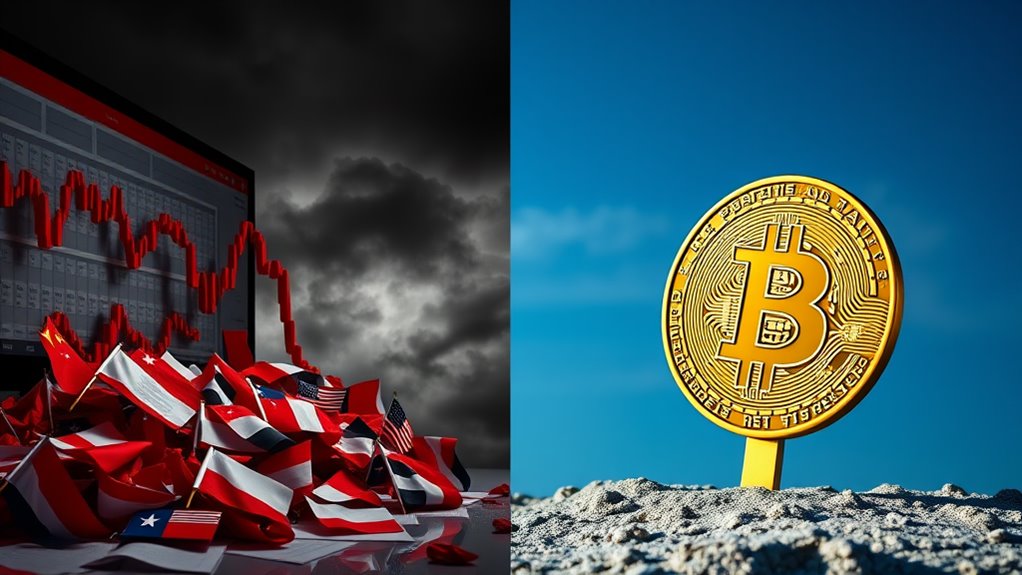
Nearly every market crumbled under the weight of recent U.S. tariff aggression, but Bitcoin stood its ground. While traditional markets took a nosedive, BTC declined just 19.1% from January highs. Equities? Altcoins? Way worse. Long-term holders actually accumulated more during the chaos. They weren’t panicking—they were shopping.
Bitcoin’s behavior has been nothing short of fascinating. When markets tanked, BTC briefly rallied. Classic decoupling. The digital asset traded at $79,850 as of April 2025, practically yawning as trade tensions escalated globally. Santiment data confirmed what many suspected: Bitcoin doesn’t care about your tariff wars.
While markets panicked, Bitcoin shrugged—hitting $79,850 amid global chaos. It doesn’t follow your economic playbook.
The fixed supply of Bitcoin makes it a compelling hedge against inflation. Government money printers go “brrr” while Bitcoin supply remains stubbornly capped. This has helped drive its 10,000% growth since inception, making gold look like an underperforming savings account. The 30-day correlation with gold has dropped significantly to negative 0.22 as Bitcoin charts its own path. The proposed Strategic Bitcoin Reserve could leverage this characteristic as a deflationary asset to protect against inflation. Unlike Bitcoin, stablecoins pegged to fiat currencies inherit the same inflation risks as traditional money.
During geopolitical crises, Bitcoin outperformed risk assets when volatility spiked. Not bad for “magic internet money.”
Countries with weak currencies have taken notice. Why be at the mercy of foreign monetary policy when you can adopt a decentralized alternative? Bitcoin reserves enable nations to function financially even during sanctions or capital controls. No intermediaries needed. Economic autonomy in digital form.
The transparency of blockchain allows governments to audit reserves in real time. Try getting that level of visibility with traditional banking systems. Impossible.
Portfolio managers are catching on too. Bitcoin’s low correlation with traditional investments makes it valuable for diversification. Unlike gold, which can be cumbersome to trade, Bitcoin markets never close. Trade at 3 AM on Sunday? No problem.
As tariffs continue disrupting global markets, Bitcoin’s resilience makes it increasingly attractive as an economic sanctuary. It’s not just surviving—it’s thriving in chaos. Some might call it digital gold. Others, the ultimate insurance policy against economic uncertainty.
Whatever the label, Bitcoin’s defiance of conventional market movements suggests its role as a financial hedge is just beginning.